Extended Warranty for Used Cars: Is It Worth It? What It Covers and What It Costs (2027)
Two products get presented after the price is settled, and both can be a reasonable buy or a poor one depending on the price and on whether the coverage actually overlaps the time you own, drive, and pay for the car. This page shows how each one works, what it does not do, what it costs on the same terms, and how the refund works if you cancel. It does not sell either one, and it does not decide for you.
Deciding right now? The questions to ask at the desk. Looking at a service contract? Work out the real miles of coverage. Already bought one? How cancellation and refunds work.
Is an Extended Warranty Worth It on a Used Car?
Whether an extended warranty is worth it on a used car comes down to two things: how much real coverage the contract gives you, held against how long you will own, drive, and pay for the car, and what that coverage costs per mile and per year. Legally the product is almost always a vehicle service contract, and that is the name this page uses for it.
An “extended warranty” sold for a separate charge is a service contract, and that changes what you are buying
A warranty comes from the manufacturer with the car. It is part of the sale and costs nothing extra. An “extended warranty” offered for a separate price is, in almost every case, a vehicle service contract: a separate product from a separate company, with its own terms, its own list of what it covers, and its own rules for getting a repair paid. The brochure says warranty because that is the word people search for. The paper you sign says service contract because that is what it is.
A “10-year / 100,000-mile” service contract is 100,000 miles of coverage, and on a used car it can be far less
Every service contract has two numbers on the cover, a number of months and a number of miles. It is natural to read the bigger one. The contract runs on the smaller one. The rest of this section is about working out which number is really yours, and then holding it up against how long you keep cars, how far you drive them, and how long you are paying for this one. The checker below does the arithmetic. It does not tell you what to do with the answer.
“Whichever comes first” means the smaller number is the real term
Look for the phrase on the contract: so many months or so many miles, whichever comes first. For a driver who covers more than 10,000 miles a year, ten years and 100,000 miles is 100,000 miles of coverage, and the miles run out long before the years. The limit you will hit first is the one that measures the contract.
Miles can count from zero or from today, and the contract decides which
There are two ways a mileage limit can be written. Some contracts measure from zero, meaning the odometer reading is the limit. Others measure from the day you buy, meaning you get the full number of miles on top of whatever is already on the car. They are very different products, and the brochure can describe both with the same words.
Take a car with 35,000 miles and a contract sold as 60 months and 100,000 miles. If the miles count from today, you have 60 months and 100,000 miles. If they count from zero, you have 60 months and 65,000 miles. Same car, same paper, one third less coverage. Take the same contract on a car with 80,000 miles. From today it is still 100,000 miles. From zero it is 20,000 miles, and the 60 months barely matter, because at any normal driving rate you will hit the mileage limit inside two years.
Ask which way the miles are counted. It is a normal question and the seller will know the answer. Then you can look at the coverage you actually have rather than the number on the cover.
On a newer car, the factory already owns the first part of the window
A new car comes with a bumper-to-bumper warranty and a longer powertrain warranty from the manufacturer. A service contract on a car still inside those does not start paying until the factory coverage ends. What it sells you is the stretch after that, up to its own cap. On a new car with a 100,000-mile contract and a 60,000-mile factory powertrain warranty, the contract’s powertrain coverage is the 40,000 miles between the two. You pay now for coverage that begins later.
On a certified pre-owned car the same thing happens with a smaller window. The manufacturer may have extended the factory coverage, which pushes the start of the contract’s coverage out, while the odometer has already used up part of a from-zero cap, which pulls the end of it in. On a car past its factory limits, say 80,000 miles against a 36,000-mile bumper-to-bumper and a 60,000-mile powertrain warranty, there is no factory coverage left, so the contract’s window starts at once. That is also where the from-zero question changes the answer the most.
Three clocks have to fit inside a service contract’s real window: how long you keep the car, how far you drive it, and how long you pay for it
Once you know a contract’s real window, test it against your own numbers. There are three.
How long you keep cars. If you trade every two years, a five-year contract buys three years of coverage you will never use. If the factory covers those two years already, it buys nothing.
How far you drive.A contract’s miles have to cover your driving for as long as you own the car. At 18,000 miles a year, two years of ownership is 36,000 miles, so a 24-month / 24,000-mile contract runs out at month sixteen. A 36-month / 36,000-mile contract covers the two years, and you are buying the third year only to get the miles. At 10,000 miles a year the time limit is the one to watch, and a shorter, cheaper contract may cover you. Which clock matters depends entirely on how you drive.
How long you are paying. This one is easy to overlook, and it can cost the most. Covered next.
A short contract on a long loan is paid for years after it expires
If you finance the contract into the loan, its price is spread across every payment for the full term. A three-year contract on an 84-month loan ends at month 36. The payments on it continue to month 84. For four years you are paying for coverage that no longer exists. There is nothing left to cancel and no way to change the payment. The same is true on a 60-month loan; the gap is just two years instead of four.
Put the three clocks together and the shape is simple. Hold the contract’s real window, in both months and miles, against the longest of the three: how long you will keep the car, how far you will drive it in that time, and how long you are paying for it. Wherever the window falls short of one of them, there is a stretch where you are paying and not covered. Seeing that stretch is what the checker is for.
Price it per mile and per year, at your own driving rate
The price of a contract means very little on its own. Two thousand dollars for 65,000 real miles is about three cents a mile. The same two thousand for 20,000 real miles is ten cents a mile. Divide the price by the coverage you actually have, then divide it again by the years you will actually get at your driving rate, and you have a cost per year you can hold up against what the car is likely to need. Some cars at some mileages make a few hundred dollars a year look cheap. Others make it look like a lot. The checker produces those numbers from what you enter. What they are worth depends on the car, on what repairs on it tend to cost, on whether you can do any of the work yourself, and on how much risk you want to carry. The repair-cost side of that question is what a vehicle history report is for.
The coverage checker puts a service contract’s months, miles, and price next to your ownership, driving, and loan
Type the contract’s numbers and your own. The checker shows the coverage you really have, where the factory already covers you, how the window lines up with how long you own, drive, and finance the car, and what the contract costs per mile and per year at your driving rate.
Enter the contract term, the mileage limit, and how the miles are counted to see the real window. The rest fills in as you add it.
For what the same contract does to the payment and to the loan total, use the out-the-door calculator.
What Does an Extended Car Warranty Cover (and Not Cover)?
A vehicle service contract pays for what its own lists cover and nothing else. What follows is how those lists are written, the wear items they treat carefully, and the parts they leave out.
The contract decides what gets paid; the seller does not
A dealer who sells a service contract is not the one who decides claims, and neither is the salesperson who described it. The administrator pays what the contract covers and declines what it does not, and it reads the list; the conversation does not enter into it.
“Powertrain,” “stated component,” and “exclusionary” describe how much of the car is covered, and the names are not standard
A vehicle service contract is a list. Either it lists the parts it covers, or it lists the parts it does not cover and covers everything else. Which kind you are looking at, and how long the list is, tells you more about what you are buying than the name on the brochure.
Every company has its own tiers, and the same word can mean different coverage at two companies
In the author’s years selling them, providers typically offered three to five levels of coverage, sometimes more. The names sound alike from one company to the next, and they are not the same product. A “powertrain” plan at one provider may cover the engine only. At another it covers the engine and transmission. At a third it covers engine, transmission, and the drive axles. All three are called powertrain, and each one lists a different set of parts inside each of those groups. Two plans with the same name can be a few hundred parts apart.
The practical version: compare plans by their parts lists and exclusions; the tier names do not compare. Two plans called “gold” are not comparable until you have both lists side by side.
A stated-component plan lists what is covered; an exclusionary plan lists what is not
Stated component, also called named component or listed component, covers only the parts it names. If a part is not on the list, it is not covered. Lower tiers are generally written this way.
Exclusionary covers every part on the car except the ones listed as excluded. Top tiers are usually written this way, and it is the closest thing to the factory bumper-to-bumper coverage the car came with.
Exclusionary is generally the broader of the two, and it is the one people picture when they say “warranty.” It is not automatically broader. An exclusionary plan with a long exclusions list can cover less than a stated-component plan with a long parts list. One quick check is the length of each: if the exclusions page runs longer than a page and a competing plan’s covered-parts list runs several, that is where the two differ. The difference in scale between the top and bottom of the range is large. As an order of magnitude, a powertrain plan covers a few hundred parts, while a top-tier exclusionary plan reaches most of the parts on the car, which number in the tens of thousands.
What is covered is decided by the contract, and the contract is the thing to read
The expectation most people bring is simple: I have a warranty, something broke, it should pay. The contract’s answer is a list, and the part that broke is either on it or it is not. Most disappointment with service contracts comes from that mismatch and seldom from a company refusing to honor what it wrote. Reading the covered and excluded lists before buying is the only way to know what you have, and it takes a few minutes. The model act requires the contract to specify what is covered and every exclusion, in clear language.
Some things to look for in the lists, on any plan:
- Which groups of parts are named under each system, and how many parts sit inside each group.
- Whether wear items are covered, and which ones. Brakes, clutches, belts, and hoses are often excluded on lower tiers.
- Whether seals and gaskets are covered. This one earns its own section below.
- Whether electronics, sensors, and modules are covered, and on which tier they start.
- What the deductible is, and whether it is per visit or per repair.
- Whether there is a labor-rate cap, a per-claim cap, or an aggregate cap on what the plan will pay.
- Whether the plan pays the shop directly or reimburses you.
- What the maintenance requirements are, and what records the provider expects. Covered next.
If a claim is denied, the denial has to point to a clause, and the model law gives you two places to take it
A denial is a reading of the contract. Ask the administrator for the denial in writing with the clause it relies on, and read that clause against the covered and excluded lists yourself. If the part is listed and the maintenance records are in order, say so in writing. Under the model law, a contract backed by a reimbursement insurance policy must tell you the insurer’s name and address, and if the provider fails to pay or provide service within sixty days after proof of loss, you may make the claim directly against that insurer. The model law also gives your state insurance commissioner authority to investigate providers and order them to stop violations, so the state insurance department is the complaint route. Your state page names the office.
Seals and gaskets are a wear item that every service contract treats carefully, and on a used car it is the coverage question to ask first
A seal or gasket has one job: keep a fluid where it belongs. Engine oil, transmission fluid, coolant, differential oil. They are made of materials that harden and shrink with heat and time, and with miles they begin to seep and then leak. On a newer car they are usually inside the coverage. On a used car with real mileage, whether they are covered is one of the more useful things to know about a plan, and one of the simplest to ask.
Seals and gaskets are covered on many new-car plans and treated differently as mileage rises
On a new or low-mileage car, an exclusionary plan generally covers seals and gaskets the same way the factory warranty does. As mileage climbs, providers handle them in several ways. Some cover them on every tier. Some cover them only on the upper tiers. Some cover them only when replaced as part of a covered repair and never on their own. Some list them as an exclusion. Some offer them as an add-on for an additional charge. The point is to know which one you are being offered. The question is short: are seals and gaskets covered, and if not, can they be added?
A car with high mileage has usually needed seal work already, and that makes the coverage question matter more there
Seals start to weep well before a car is old. As a rule of thumb from the service side, seepage shows up on cars past 60,000 miles, and a car past 100,000 miles has often had some replaced already or is due. That is normal wear, and it is expensive to fix, because getting to the seal is most of the labor. On a used car, then, the part most likely to need work in the near term is the one whose coverage varies most from plan to plan.
A service contract conditions coverage on maintenance, so a leak that is not repaired can undo the rest of the coverage
A service contract’s coverage is conditioned on the maintenance duties the contract sets out, which the model act requires it to state, and those routinely include keeping fluids at the proper level and keeping records of it. A provider cannot insure an engine that is run without oil. But it interacts with seals in a way that catches people. If a seal leaks and is not repaired, whether because it was excluded or because it was put off, and the fluid runs low and a covered component fails as a result, the maintenance clause can apply to that failure. The engine that failed was covered; the reason it failed was not.
The way through is the same as everywhere else on this page: know whether seals are covered, decide whether to add them if not, and if a leak shows up during the contract, repair it and keep the receipt. A maintained car with records is a car whose covered claims get paid.
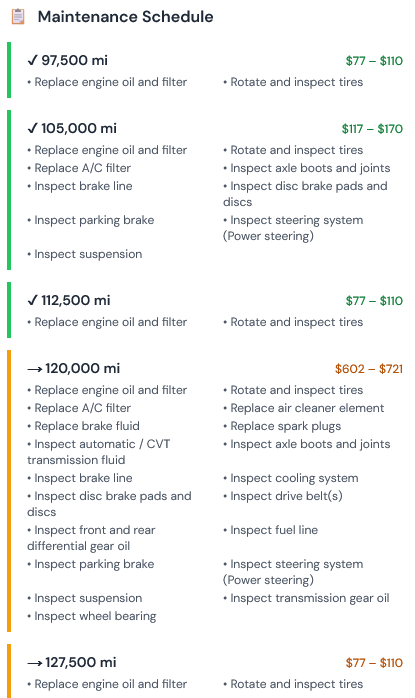
Maintenance is the part a service contract does not pay for and does require. A report lays out the schedule for the specific car by mileage, with what each interval costs, so you can see what keeping the contract in force will cost you alongside the contract itself, and which intervals have already passed on a used car. The receipts for those intervals are what a claim is checked against.
Parts that are known to fail at a certain mileage are usually excluded, priced higher, or sold only before that mileage
A service contract provider is in the business of pricing risk. It knows the typical service life of the components on the cars it covers, and it sets coverage and price so that, across all the contracts it sells, it pays out less than it takes in. That is how any insurance works, and it explains most of what looks puzzling in a coverage list.
A part with a known failure window is treated as maintenance, not as a random failure
Insurance covers unexpected events. A component that predictably wears out at a certain mileage is not unexpected; from the provider’s side it is a scheduled expense with a date attached. So a part with a well-known failure window is handled one of three ways: it is excluded, it is covered at a higher price, or it is covered only if the contract is bought before the car reaches a certain mileage, often while the factory warranty is still in force. Air suspension systems are a common example; so are some infotainment and driver-assistance electronics, and on some models specific transmissions or turbochargers.
Life insurance does the same thing. A person with a serious diagnosis pays more or is offered a different policy, and a policy can exclude certain causes for its first year or two. The provider is removing the predictable from the unpredictable pool. A car works the same way, one component at a time.
The provider knows the life expectancy of your car’s parts, and the coverage list is where that knowledge shows
Buyers rarely know which parts on their car are approaching end of life. Providers do; it is the core of their pricing. When a plan excludes a specific system on a specific model, or prices it as a surcharge, that is information. It usually means the provider expects that system to need work inside the contract term. That does not tell you whether to buy the plan, but it tells you where the car’s known costs are, which is useful whether you buy coverage or not.
A VinPassed vehicle history reportcarries repair-cost and reliability projections for the specific car, by mileage. Held next to a plan’s coverage list, it shows which of the car’s likely repairs the plan covers, which it excludes, and roughly what each would cost uncovered. That is the comparison the provider has already made; the report lets you make it too.
Coverage gets narrower and scarcer as a car ages, and at high mileage it may not be offered at all
As more of a car’s components reach the end of their service life, more of them fall into the predictable pool. Plans available at 60,000 miles are broader than the ones available at 120,000, and on in the author’s experience the market thins out somewhere past 150,000 to 200,000 miles, because at that point a large share of the parts are at or near their expected life and the provider cannot price the risk. That is not a judgment about the car. It is the same reason a 90-year-old is not offered a 30-year life policy.
How Much Is an Extended Warranty for a Used Car?
No price is fixed or disclosed: what an extended warranty costs on a used car is set by whoever sells it, and the same contract can be sold for very different amounts. Below are an illustration of how wide that spread can run, how to judge a price against the car, and what a monthly quote adds up to over the loan.
The same service contract can be sold at very different prices, and the price is what turns it from peace of mind into a bet
A service contract has a cost to the seller and a price to you, and the distance between them is set by the seller. It is not disclosed and it is not fixed. The same contract, from the same provider, with the same coverage, can be sold at a modest markup by one seller and at several times that by another. For illustration only: a contract that costs a seller $1,500 might be sold for $2,000 at one store and $6,500 at another. Those are not quoted figures; they are the shape of the range as the author saw it, and the point is the width of it, not the endpoints.
At one end the contract buys what you wanted; at the other you need a major repair just to break even
Think about what the contract has to do to earn its price. At a modest markup, one ordinary repair inside the term returns most of the cost, and everything after that is the peace of mind you were buying in the first place. At a large markup, the contract has to pay for a transmission or an engine before you are even, and if the car does not have that failure inside the window, the money is gone. Somewhere between those two prices the same contract stops being coverage and starts being a wager on a breakdown. Where that point sits depends on the car, the coverage, and your own view of risk. The price is the variable that moves it.
A reasonable price is one you can hold up against the car’s likely repairs
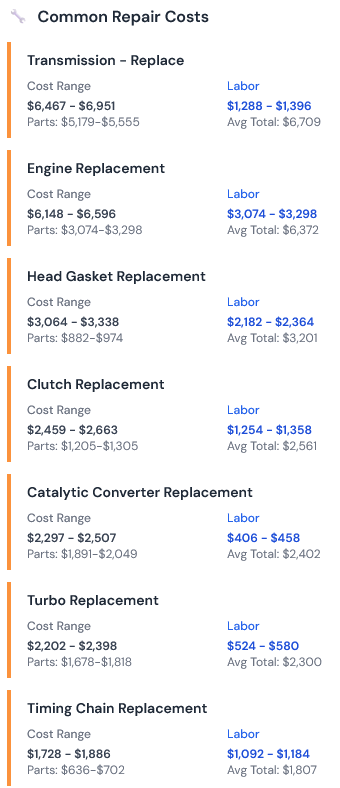
The way to judge a price is the way the provider does: against what the car is likely to need. The checker above turns a price into a cost per mile and per year of real coverage. A vehicle history report’s repair-cost projections give you the other side, what the common failures on that car tend to cost and at what mileage. Set the two next to each other and the question becomes concrete: for this car, at this mileage, is this much per year for this coverage a reasonable trade? What the comparison prevents is paying a price that no plausible repair history on the car could ever return.
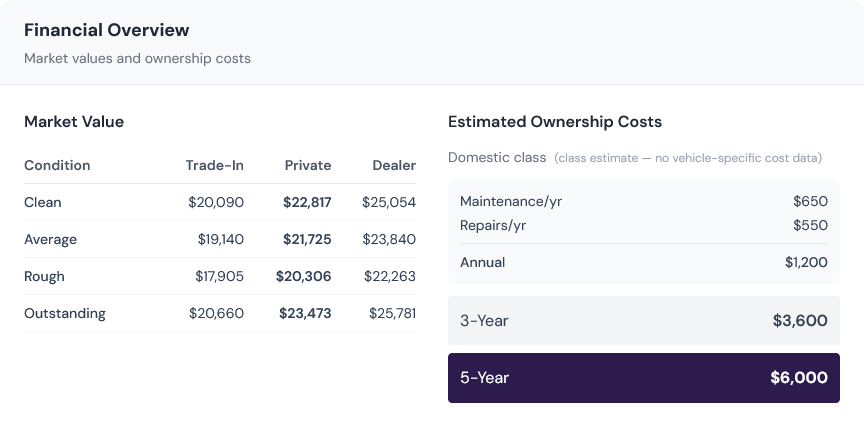
A VinPassed reportfor the specific car gives you the rest of the numbers a service contract has to be measured against: what the car is worth today at trade, private, and dealer; what it costs to maintain and repair per year and over three and five years; and which service is due at its mileage. With those next to a contract’s price per year of real coverage, the question “is this a reasonable price for this car” has something to be answered with.
One consequence of the markup range: a reference quote changes the conversation. A price for the same or comparable coverage from your credit union, from the manufacturer’s own plan, or from a provider selling direct gives you a number to compare against. In the author’s experience, dealers will often move on service-contract price when there is a competing figure on the table.
“Just $10 a month” is not a price until you know how many months, and the months can change with the product
Add-on products are usually quoted by what they add to the monthly payment. That is a fair way to describe them, and it is also incomplete, because a monthly amount only becomes a price when it is multiplied by a number of months, and that number is the loan term. The same $10 a month is $600 on a 60-month loan and $840 on an 84-month loan.
| “$10 a month” over | Total paid |
|---|---|
| 60 months | $600 |
| 72 months | $720 |
| 84 months | $840 |
The larger cost is the term itself, when it is extended to keep the payment where it was
When products are added, one way to keep the payment near the number you had in mind is to lengthen the loan. The products are the part you see. The added months are the part that costs the most, because every added month is a full payment, not a ten-dollar one.
| Your monthly payment | Loan stretched 6 months | Loan stretched 12 months |
|---|---|---|
| $300 / month | $1,800 | $3,600 |
| $500 / month | $3,000 | $6,000 |
| $700 / month | $4,200 | $8,400 |
Payments times months added. Interest on the longer term adds to these figures.
Both tables are floors, because interest accrues on every dollar across the longer term. The question that surfaces all of it is one sentence: what is the loan term, and did it change when the products were added? If the term moved, the whole deal moved, and the out-the-door calculator will show by how much.
One more consequence: a term that was extended to fit a product in stays extended after the product is cancelled. The refund goes against the balance; the months do not come back.
Can You Buy an Extended Warranty on a Used Car After You Buy It?
Usually, yes, and from more than one source. A manufacturer’s plan can generally be bought from any franchise dealer of the brand, with the brand setting a mileage cutoff; third-party providers sell vehicle service contracts direct; and some credit unions sell them to members. What changes after the sale is the price and the coverage available, since providers price by the car’s mileage at purchase. A contract bought later is not financed into the original loan.
Coverage also narrows as the miles add up: a part with a known failure window may be covered only on a contract bought before a certain mileage, and at high mileage a plan may not be offered at all (how coverage is priced).
The “final notice” warranty calls and mailers are not from your manufacturer, and there is no deadline
The call or letter announcing that your vehicle’s warranty is about to expire, and that this is a final opportunity to extend it, is common enough that the Federal Trade Commission has published a consumer alert about it. These are marketing for third-party service contracts. Neither the manufacturer nor the selling dealer is behind them, and the deadline is a sales device. Federal regulators have warned about this category of call for years.
If you want to know whether the factory warranty is in force, the manufacturer can tell you from the VIN
Your manufacturer’s owner site or any franchise dealer for the brand can look up the in-service date and the coverage remaining. That is the actual answer to the question the call is asking. If you decide you want a service contract, you can shop for one on your own schedule from any of the sources in the next section and read it against this guide. Nothing in this market has a deadline that a phone call sets.
A legitimate service contract names its provider and administrator, shows the whole contract before payment, and states a total price
- A named provider and a named administrator, with the provider’s financial backing stated in the contract.
- The full contract available to read before any payment, including the covered and excluded lists and the cancellation clause.
- A price stated as a total, not only as a monthly amount, and a free-look period after purchase.
- No pressure to decide on the call. A real offer is the same price tomorrow.
Dealer vs. Third-Party Extended Warranties
“Dealer” and “third-party” describe who sells a vehicle service contract and who stands behind it, and those are often different companies: a dealer may offer the manufacturer’s plan, a third-party plan, or both.
Three parties are involved, and the one you deal with at a claim is the administrator
The seller is whoever presents it to you, most often a dealer, a lender, or a company selling direct. The provider is the company that stands behind the contract financially. The administratoris the company that approves and pays claims and handles cancellations; sometimes it is the provider, sometimes a separate firm. The administrator’s name and phone number are on the contract. When something breaks, that is who the repair shop calls for authorization, and that is who you call to cancel.
A service contract can be bought from four kinds of seller, and the dealer’s is one of them
- The dealer, at the finance desk. Convenient, financeable into the loan, and priced by the dealer. The dealer may offer the manufacturer’s plan, a third-party plan, or both.
- The manufacturer’s own plan, which can usually be bought from any franchise dealer of that brand, including ones that did not sell the car, and is honored at the brand’s dealers. Whether it can still be bought after the sale, and until what mileage, is the brand’s rule; any of its dealers can tell you.
- Your bank or credit union, which often offers a service contract alongside the loan, frequently from a third-party provider, and frequently at a lower price than the same coverage carries at the dealer.
- Providers selling direct, by phone or online. Coverage and price vary widely, and the provider’s financial backing and the administrator’s reputation matter more here than anywhere else, because there is no dealer in between.
Whichever source you use, the contract is the same kind of document and the same eight questions apply. A quote from a second source before the finance-office conversation gives you a reference price for the first.
At the finance desk, these questions get the facts out of the product before the price goes into the loan
Each one has a short answer the seller has. Each links to the part of this page that explains what the answer means.
Eight questions that get a service contract’s real terms on the table
- How many months and how many miles, and do the miles count from zero or from today?
- Is it exclusionary or a listed-parts plan, and can I see both lists?
- Are seals and gaskets covered, and if not, can they be added?
- What is the deductible, and is it per visit or per repair?
- Is it cancellable after the free-look period, and what is the refund formula?
- What is the price as a total, and what is the loan term now compared with before the products were added?
- Who is the administrator, and who backs the contract?
- Can repairs be done at any licensed shop, including where I live, and who pays the shop?
If the answers arrive as monthly amounts, the out-the-door calculator turns them back into totals.
How to Cancel an Extended Warranty and Get a Refund
If you signed recently, the clock that matters is the free-look period, and it started at signing.Inside it, a GAP waiver or a service contract can be returned for a full refund if no claim has been made. The window is set by your contract and your state: for a GAP waiver, your state’s GAP-waiver act sets the minimum and your state page names it; for a service contract, the model act requires at least twenty days from mailing or ten from delivery at the sale. Today, then: find the contract or the addendum in your paperwork, read its cancellation clause for the window and the procedure, and send the cancellation in writing to the administrator or provider named on it, with a copy to the dealer or lender. Keep a dated copy. If you cannot find the paper, the dealer or the lender has it. The rest of this section is what happens to the money.
Cancelling a financed product lowers what you owe at the end of the loan, and changes nothing about the payment
This is the mechanic to understand before deciding either way, because it is the opposite of what most people picture. When a GAP waiver or a service contract is financed, its price was added to the amount you borrowed. It is inside the loan. When you cancel, the refund of the unused portion, less any fee the contract allows, goes to the lender and is applied to the loan balance. The loan itself does not change. The payment stays the same. The term stays the same. You simply reach the end of the loan owing a little less, or finish a little sooner if the lender applies it that way.
So cancelling next week does nothing to next month’s payment. If you are on the fence at the desk because you assume you can cancel and get the payment back down, that assumption is the thing to check. Cancelling still lowers what you pay overall. It is not a reset. A product that never goes into the loan has nothing to refund.
Inside the free-look period, if no claim has been paid, the refund is the full amount. After it, the refund is pro rata, the unused share of the term, less a fee if the contract allows one. If you paid for the product outright rather than financing it, the refund comes to you.
Cancelling a service contract: the administrator’s form, the odometer reading, and a written confirmation
A service contract is cancelled through its administrator, not through the dealer, on the administrator’s form. The form typically asks for the current odometer reading, and some administrators require the request in writing; the contract’s cancellation clause says which. Ask for written confirmation of the cancellation and of the refund amount. If the contract was financed, the refund goes to the lender as above; if you paid outright, it comes to you.
Work the paperwork in this order:
- Your own contract. The cancellation clause is the controlling authority: it states the free-look window, the refund formula, any fee, and where the refund goes. If you still have the paper, start there.
- Whoever sold it. If you cannot find the contract, the dealer, or the bank or credit union that financed the deal, keeps a copy and can tell you who administers it.
- The administrator. Every path ends here. Its name and number are on the contract, and cancellation is completed on its form.
The federal basis for the free-look right on service contracts, and the model-law refund rules, are on the resources page; the steps above are the practical version.
Selling or trading the car: a service contract can transfer, cancel, or ride along unused; GAP ends with the loan
Both products are tied to the car and the loan, so a sale or a trade is a cancellation event, and it is easy to leave money on the table. A service contracthas three possible fates. It can transfer to the buyer, usually for a fee and usually only within the contract’s mileage and time limits; the model act requires every contract to state its transfer terms, so the answer is in the paper. On a private sale a transferable contract is something a buyer pays for, and the listing can say so. It can be cancelled by you for the pro-rata refund, on the administrator’s form, before or right after the sale. Or it can be forgotten and expire unused. On a trade-in, in the author’s experience, the contract is rarely credited toward the trade; cancelling it yourself, with the odometer reading from the day of the trade, is what gets the refund. Where the contract was financed, the refund goes against the loan you are paying off, which lowers the payoff figure.
GAP has no role in a sale. It covers a total loss, not a sale below the balance; if you owe more than the car sells for, GAP does not pay the difference, and that shortfall is the negative-equity problem on the negotiation page. What GAP does at a sale is end. A waiver ends with the loan it was attached to, and the unused portion refunds as described under cancelling GAP, on a written request; insurance GAP ends when you drop the endorsement.
Some service contracts cannot be cancelled after the free-look period, and on those the price is final
Many service contracts can be cancelled at any point for a pro-rata refund of the unused portion, less a fee. That is a term of the contract, not a rule. The model law gives you a free-look period to return the contract for a full refund; beyond that window, nothing in the model law requires a contract to be cancellable, and some are written as non-cancellable. On those the money is committed for the full term regardless of whether you keep the car, pay off the loan, or find the coverage was not what you expected. A lender’s paperwork can reserve the right to cancel a financed contract if the loan defaults, with the refund coming back to the lender; that right belongs to the lender. If you have paid too much for a contract that cannot be cancelled, there is no path back to the money.
The cancellation clause is a short paragraph in the contract. It states whether the contract is cancellable, the free-look window, the refund formula after it, any fee, and where the refund is sent. Reading it before signing answers all of that. On a non-cancellable contract the price and the coverage have to be right the first time, because there will be no second look.
The model law says a seller or lender may not require a service contract as a condition of the sale or the loan
The NAIC model law for service contracts says a lender, manufacturer, or seller may not require the purchase of a service contract as a condition of a loan or of a sale. States adopt the model in their own form, and not every state has adopted that provision, so whether it is the law where you are is on your state page. A lender can require you to keep auto insurance on a financed car; that is a different product and a different rule. If a service contract is described as necessary for financing approval, you can ask which lender requires it and see that requirement from the lender. The legal section below names the model provision.
If you do decide to buy a contract that was presented as required, the cancellation clause matters twice: once because it is your way out if the price turns out to be high, and once because a contract that cannot be cancelled and was presented as required leaves you with neither the money nor the choice.
Is GAP Insurance Worth It?
That is the question most people are really asking, and it has two parts. The first is whether a gap exists at all. The second is whether, for you, covering it is worth the price. The first part is arithmetic. The second is personal, and this page does not answer it for you.
GAP covers one event: a total loss or theft while you owe more than the car is worth
Guaranteed Asset Protection, or GAP, covers one event. If the car is totaled or stolen and not recovered, your auto insurer pays what the car was worth. If you owe more than that, GAP pays the difference to the lender, so the loan is cleared rather than left as payments on a car you no longer have.
A gap exists wherever the loan balance sits above the car’s value, and it closes on its own
Compare what you owe with what the car is worth, and think about how that comparison moves. The loan balance falls a little each month. The car’s value falls faster early on, then slows. Wherever the value sits below the balance, there is a gap. Once the balance drops below the value, the gap is closed and GAP has nothing left to cover.
Things that make the gap larger or keep it open longer: a small down payment or none; a long term, because the balance comes down slowly; negative equity rolled in from a trade, which starts the loan above the car’s value on day one (how that number comes about is on the negotiation page); financed add-ons, fees, and tax, which raise the balance without raising the value; and a car that loses value quickly. Things that make it smaller or close it sooner: a large down payment, a short term, a car that holds value, or a used car bought below what similar cars sell for.
If there is no gap, there is nothing for the product to do, and some states write that into their GAP-waiver acts by barring the sale of a waiver to a borrower who could not benefit from it; your state page says whether yours does. The out-the-door calculator shows the balance over time; a value estimate comes from a pricing guide or from what similar cars are selling for.
Whether covering the gap is worth it depends on things only you know
Once you know roughly how large the gap is and how long it lasts, the decision depends on your own situation.
- What losing that amount would mean. A few thousand dollars owed on a car that is gone lands differently in different households, and that is the first number to put next to the price.
- Your savings and other coverage. Cash on hand, or an auto policy that already includes new-car replacement or a loan payoff provision, changes the picture.
- The size of the gap against the price of covering it. A gap of a few hundred dollars that closes in a year is a different proposition from one of several thousand that lasts four. The cost section below shows how to put a total price on the coverage.
- How long the gap lasts against how long you will keep the car and the loan. If you expect to sell or refinance early, the window may be short.
- How you feel about the risk. Total losses are uncommon and, when they happen, expensive. Some people insure that kind of risk and some keep it.
On a used car the comparison is the same, and the gap often closes sooner
GAP is not only a new-car product. A used car bought with little down on a long loan can be underwater just as easily, and one with financed add-ons can be underwater from the first payment. Used-car depreciation is slower, and the gap tends to close earlier. The comparison is the same. Run it on your numbers; the car’s age is not the test.
GAP pays the difference between what your insurer pays and what you still owe, with limits written into the contract
Here is what a claim looks like, step by step.
- The car is declared a total loss by your auto insurer, or stolen and not recovered within the policy’s waiting period.
- Your insurer settles for the car’s actual cash value, less your deductible, and sends that amount to the lender.
- The lender reports the remaining balance.
- GAP pays the lender the difference between the settlement and the balance, up to the limits in the GAP contract. Some GAP contracts also pay your insurance deductible up to a stated amount; many cap that at a fixed figure.
- Any part of the balance the contract does not cover is still yours.
Actual cash value is the insurer’s number, and GAP pays from it rather than arguing with it
Actual cash value is what a similar car would sell for now, and it can differ from what you paid. GAP does not dispute that figure; it pays the difference from it. If you think the settlement is low, that conversation is with your auto insurer, before GAP is calculated.
Nothing comes to you. GAP is paid to the lender to clear the loan. Once the loan is cleared, you owe nothing on the car, and that is the whole benefit.
Not every GAP contract pays everything you owe; most have limits, and the exclusions are the part to read
A GAP waiver can cancel all of what is owed or only part of it; some contracts have no cap, and most have limits. The searches for “when does GAP not pay” are mostly about the same handful of them. They vary by contract and by state, which is why the contract itself is the place to check, but these are the usual ones.
- Late payments, late fees, and deferred payments. Where the contract calculates the covered balance as if you had paid on schedule, anything you fell behind on is excluded.
- A balance above the contract’s limit. A cap on the covered amount, stated as a percentage of the car’s value at purchase, as a loan-term limit, or as a dollar figure. Negative equity rolled in above a cap is not covered. A contract with no cap does not have this exclusion.
- Financed add-ons above a cap, or the refund portion of them. Some contracts cover a service contract or other financed product only up to a stated amount, and some subtract the refund you could get by cancelling those products.
- The deductible, beyond the stated amount. If the contract pays a deductible at all, it is usually up to a fixed limit.
- Anything your auto insurer did not cover. GAP starts from an insurance settlement. If there is no settlement, because the loss was not covered or the policy had lapsed, there is nothing for GAP to bridge. Many contracts require comprehensive and collision coverage to stay in force for the whole loan.
- Losses that are not a total loss. GAP has nothing to do with repairs, breakdowns, or partial damage. Those are the service contract’s territory, if they are anyone’s.
- Some uses and some causes. Commercial use, racing, driving under the influence, and fraud are common exclusions.
- Refinancing. A waiver is attached to the finance agreement, so refinancing ends it unless the provider transfers it. Some providers will transfer it or refund the unused portion; the new loan needs its own coverage decision.
The contract lists its own exclusions in one place. Reading that page before signing takes a few minutes and answers most of these for the product in front of you.
GAP is sold three ways, and which one costs least depends on how long you carry it
GAP can come from the dealer, from your bank or credit union, or from your auto insurer as an add-on to your policy. The coverage is broadly similar. The price and the structure are not.
- Dealer GAP is a one-time charge, usually financed into the loan, which means interest on it for the full term.
- Lender GAP from a bank or credit union is also a one-time charge, and in our experience it tends to run lower than the dealer’s price for comparable coverage.
- Insurer GAP is a monthly charge on your auto policy for as long as you keep it, and it can be added after the sale as well as at the desk, if the insurer offers it and the car qualifies.
A monthly charge and a one-time charge cannot be compared until both are on the same term
Comparing them takes one step, and it is the step most comparisons skip: put all three on the same term. A monthly charge sounds small because it is quoted small. A one-time charge sounds large because it is quoted whole. Neither number means anything until it is stretched across the months you will actually carry the coverage.
Do it in either direction. Multiply the monthly charge by the months of the loan to get a total. Or divide the one-time charge by the months of the loan to get a monthly equivalent. Same answer, and now the three can sit next to each other. The numbers below are examples to show the arithmetic; they are not quoted prices.
| Illustrative | Quoted as | Over 60 months | Over 84 months | Monthly equivalent (60 / 84) |
|---|---|---|---|---|
| Insurer add-on, low end | $5 / month | $300 | $420 | $5 / $5 |
| Insurer add-on, high end | $20 / month | $1,200 | $1,680 | $20 / $20 |
| Credit union, one-time | $400 | $400 | $400 | $6.67 / $4.76 |
| Credit union, one-time | $600 | $600 | $600 | $10.00 / $7.14 |
| Dealer, one-time | $800 | $800 | $800 | $13.33 / $9.52 |
Example amounts chosen to show the arithmetic. They are not quoted prices from any dealer, lender, or insurer.
Read across a row and two things show up. The low-end monthly add-on is inexpensive on any term, and it stops costing you the day you drop it. The high-end monthly add-on, carried for the length of a long loan, costs more than either one-time price in the table, including the dealer’s. The one-time charge is not always the expensive option; it depends on the term. Two footnotes on the one-time charges: if they are financed into the loan you pay interest on them, which raises the real total a little, and if you pay the loan off early the unused part refunds to the balance rather than to you (covered in the cancellation section). The monthly add-on has neither issue; it simply ends.
The same habit applies to every product quoted per month at the finance desk. A payment can be made to fit a budget by stretching the term, and the product rides along inside the difference. The total over the term is the number that does not move. The out-the-door calculator shows the whole-loan effect of adding any product.
If you decide GAP makes sense, a quote from your credit union or insurer before the finance-office conversation gives you a reference price. In the author’s experience, dealers will often move on GAP price once there is a competing figure on the table.
Diminished value is the drop in a car’s worth from having an accident on its record, and it applies to repaired cars as much as totaled ones
GAP and diminished value get presented together at the finance desk, and they are often confused, so it is worth setting them side by side. GAP covers one event: a total loss while you owe more than the car is worth. Diminished value covers something quieter that happens to a car with an accident on its record, including cars that are repaired well and driven for years afterward.
A repaired car is worth less than the same car with a clean history, and the difference is real money at trade or sale
Once an accident is on a car’s history, buyers pay less for it. The repair can be excellent and the car can drive exactly as it did, and it will still sell or trade for less than an identical car with no accident on record. That difference is diminished value. It shows up at the moment you sell or trade, and on a car with a significant repair it can run into the thousands. It does not depend on owing anything on the car; a car paid for in cash loses it too.
Who was at fault decides whether an insurer will pay diminished value: in many states the other driver’s insurer will, and in one state your own must
If another driver was at fault, many states let you claim diminished value from that driver’s liability insurer as part of the property damage, separate from the repair itself. If you were at fault, the question is whether your own collision coverage pays it, and Georgia is the one state with a clear legal direction that it does. A narrower case: if the other driver was uninsured, uninsured-motorist property damage coverage treats you as a third-party claimant, and a diminished-value claim can be presented under it. The amount is where the work is: the formula an insurer applies and an independent appraisal can come out far apart. Your state’s insurance department describes which route your state allows, and this is a place where the answer genuinely changes at the state line.
In practice the amount tends to run around a tenth to a fifth of the repair bill
There is no standard formula. A 2023 study published in the National Association of Insurance Commissioners’ Journal of Insurance Regulation reports that diminished value ultimately ends up at about 10 to 20 percent of the physical-damage loss, so a $10,000 repair tends to produce a claim in the range of $1,000 to $2,000. Georgia has historically used a formula called 17(c): one tenth of the car’s retail value, reduced by a damage modifier and a mileage modifier. The same study calls that formula controversial.
The finance-desk version is a product that pays a stated amount after a covered repair, and its fault rule is in its contract
Separately from any claim, some dealers and lenders sell a diminished-value product at the desk. It pays a set amount, or a set percentage of the car’s value, after a covered accident repair, without an appraisal or a claim against anyone. It is sometimes bundled with GAP and sometimes offered on its own. Because it does not depend on a loan balance, a dealer may offer it instead of GAP when you have a large down payment, a short term, or no gap to cover, or alongside GAP when you have one.
The first thing to read in one of these is the fault rule, because products differ. Some pay after any covered accident regardless of who caused it, which is the one thing an insurer will not do in most states. Others pay only when another driver was at fault, and some of those are less a coverage than a service that pursues the claim against the other insurer for you. Those are very different products at similar prices, and the contract says which one you are looking at.
After the fault rule, the questions are the same as for any product on this page. What counts as a covered repair, and whether there is a minimum repair cost to trigger it. How the payment is calculated, and what the cap is. What is excluded. What it costs on the same term as everything else. And what you could already recover without it: if you would not be at fault and your state allows the claim, the product is paying for something you may have a right to anyway, though it pays without the claim and without the appraisal. If the product covers at-fault accidents, it is paying for something your own insurer, outside the states that require it, would not.
Four questions that get GAP’s real terms on the table
- What is the amount financed against the car’s value today, and how long will the balance stay above it?
- Is this a waiver or insurance, and what is the total price over the loan term?
- What is the coverage limit, and does it pay the deductible?
- Is it cancellable after the free-look period?
GAP Waiver vs. GAP Insurance
A GAP waiver and GAP insurance both pay the gap between the insurance settlement and the loan balance. They get there by different routes, and the route affects when you can buy it, who regulates it, and how it refunds.
A GAP waiver is part of your financing, written when the loan is written
A GAP waiver is an addendum to the retail installment contract in which the lender agrees to waive, or cancel, the part of the debt that remains after a total loss. Because it is a term of the loan, it is written when the loan is written, at the sale. It is regulated as a debt-cancellation product under state GAP-waiver laws, not as insurance, and it is the product a dealer or a credit union sells.
GAP insurance is an endorsement on your auto policy, and it can be added later
GAP insurance is a contract with your insurer instead of your lender, so it can be added when you buy the car or afterward, where the insurer offers it and the car is eligible. It is regulated as insurance by your state’s insurance department. It is the product that bills monthly and stops when you drop it.
Waiver or insurance changes when you can buy GAP, how it refunds, who you call, and which law applies
- Timing. If you declined a waiver at the desk and change your mind later, the insurance route is usually still open. The waiver route generally is not.
- Refunds. A financed waiver refunds to the lender against the balance; insurance simply stops billing.
- Who to call. A waiver claim runs through the waiver provider named on the addendum; an insurance claim runs through your insurer.
- Rules. Waiver terms, including the free-look period and refund method, come from your state’s GAP-waiver law and the addendum. Insurance terms come from your policy and state insurance law. Your state page names the law that applies where you live.
The two terms get used interchangeably in advertising and in search, and this page uses both. If a dealership offers you “GAP insurance” with the financing and the paper is an addendum to the finance agreement, it is a waiver by definition. That is not a problem; it is just the correct name for what you are being offered.
Cancelling GAP: a waiver refunds to the lender, insurance simply stops billing
Which kind of GAP you have decides how cancellation works. A GAP waiversold with the financing is cancelled through the provider named on the addendum, on its form, and the refund follows the rule above: to the lender, against the balance. State GAP-waiver laws set a free-look period for a full refund and require the waiver to state whether it can be cancelled at all after that period, so a waiver can be written as non-cancellable once the free-look period ends; your state page names your state’s rules. When the loan is paid off early, the waiver ends and the unused portion refunds the same way, and there can be a deadline on asking: some state acts require the waiver to set a number of days after the payoff within which the refund must be requested in writing, and your state page names yours. A written request to the provider right after payoff settles the question of a deadline wherever you are.
GAP insurance from your auto insurer is an endorsement on the policy. Cancelling it is a call to the insurer to remove the endorsement, and it stops billing from that point. There is no refund to chase, because there was no lump sum.
Service contracts follow a model law many states have adopted; GAP waivers follow state debt-cancellation laws; the federal layer is disclosure
Service contracts: the NAIC Service Contracts Model Act, adopted state by state
The framework many states use for service contracts is the National Association of Insurance Commissioners’ Service Contracts Model Act, Model #685. The NAIC is not a regulator; it drafts model laws that states adopt in their own form, so the operative text is your state’s statute. The model provisions that matter to a buyer:
- A service contract is not a warranty (§ 2). A warranty is incidental to the sale and has no separate charge; a service contract is a separate agreement for a separate consideration.
- The provider must be financially backed (§ 3C), by a reimbursement insurance policy, by a funded reserve plus a deposit, or by a stated minimum net worth, so that claims can be paid if the provider fails.
- The contract must be in plain language and disclose the price, the coverage, the exclusions, the deductible, and the terms for transfer and cancellation (§ 5). This is why the covered and excluded lists exist as documents you can read before buying.
- A free-look right to return the contract for a full refund if no claim has been made: at least twenty days from mailing, or ten days if delivered at the sale, with a ten percent per month penalty added to refunds not paid within thirty days (§ 5L). The model requires the contract to state its own terms for cancellation after that (§ 5K); it does not require that cancellation be allowed.
- No required purchase. A provider may not require the purchase of a service contract as a condition of a loan or of the sale (§ 6C).
The model text and the NAIC’s state-adoption chart are linked from the resources page, which holds the federal and model-law apparatus for the whole series so that it is written once. Your state page reports how your state adopted the model and what its free-look length is.
GAP waivers: state debt-cancellation laws, with free-look and refund rules
GAP waivers are governed by state law; there is no single national model with universal adoption, and the state acts follow a common shape. They define a GAP waiver as an agreement, part of or an addendum to the finance agreement, in which the creditor agrees for a separate charge to cancel all or part of what is owed after a total loss or unrecovered theft, and they treat it as a debt-cancellation product rather than as insurance. The questions each act answers, and that your state page answers for you: how long the free-look period is; whether the waiver may be non-cancellable after it; whether a cancellation fee is allowed; how a financed refund is applied; whether credit or its terms can be conditioned on the waiver; and what remedies a borrower has. The statute is cited and verified on the state page, which is where that level of detail belongs.
What the statutes give a buyer who was wronged: a refund penalty under the model act, and state-level remedies that vary
The remedies are specific and small-scale. Under the model act, a free-look refund not paid within thirty days of the contract’s return draws a ten percent per month penalty, and enforcement runs through the state insurance commissioner rather than a private lawsuit. State GAP-waiver acts add remedies of their own, and they differ: some void a waiver that was sold to a borrower who could not benefit from it and refund the full price, and some give the borrower a civil action with actual damages, attorney’s fees, and court costs. Fee-shifting is what makes a few-hundred-dollar dispute worth an attorney’s time; whether your state’s act includes it is on your state page.
The federal layer: disclosure, and the line between optional and required
Federal law does not regulate GAP or service contracts as products. It regulates how their cost is disclosed in a credit transaction. Under the Truth in Lending rules, a debt-cancellation product such as a GAP waiver is treated as a separate charge rather than as part of the finance charge only if it is voluntary, that is disclosed in writing, and the consumer affirmatively agrees to it. That is the reason the paperwork says, in so many words, that the product is optional and not required to obtain credit. The federal apparatus behind that, and the rest of the federal consumer-credit layer, is on the resources page.
Frequently asked questions
The free-look period, the GAP statute, and the refund rule are state law: your state page names them
Everything above is how these products work in practice. The parts that are law are state law: how your state adopted the service-contract model act, the length of the free-look period, which statute governs GAP waivers, whether a cancellation fee is allowed, and how a financed refund has to be applied. Those live on your state page, with the statutes cited and verified, alongside the finance-office section that shows the same products at the moment they come up in a deal. Start from the state comparison table and pick your state.
Buying in one state and registering in another: the waiver and the service contract follow the state where they were sold; GAP insurance follows your policy
Each state’s acts apply to the contracts sold inside that state. The service-contract model act is written as rules for contracts sold in the state, and state GAP-waiver acts are written the same way. So if the dealer is in one state and the title will be in another, the free-look period, the refund rule, and the required-purchase rule that apply to the paper you sign at the desk are the dealer’s state’s, and that is the state page to read before you sign. GAP insurance is different: it is added to your own auto policy, which is your state’s product wherever you bought the car. For a service contract used far from where it was bought, the question to ask is whether repairs can be done at any licensed shop, including where you live; that is a contract term, not a law.