Carfax Alternatives: What to Use Instead of Carfax
"What's a good alternative to Carfax?" usually comes down to one of two things: you want the same core history for less money, or you want data Carfax doesn't carry at all. Those are different questions with different answers, so we'll take them separately.
The short answer
The closest like-for-like Carfax alternative is AutoCheck at $29.99, about $20 under Carfax's $49.99. VinAudit at $9.99 covers title basics. VinPassed at $30 adds what Carfax leaves out: repair cost estimates, upcoming maintenance, known model problems, and on auction cars the pre-sale photos and the dealer's price. Prices checked October 25, 2026.
What does Carfax do well?
Carfax built this category, and its core data is solid: accident records from a broad set of insurance partners, title history, deep service records, and recalls. Its Buyback Guarantee (for DMV-reported title brands missing from the report) is a feature no one else offers. The knock isn't that Carfax is bad. At $49.99 a report it's the most expensive option, it's built around the dealer who's selling the car rather than the buyer evaluating it, and it doesn't include certain data at all.
So "alternative" can mean cheaper for the same core data, or more than Carfax covers.
What is the cheapest Carfax alternative?
AutoCheck (owned by Experian) is the closest like-for-like. At $29.99 it runs about $20 under Carfax, pulls from the same kinds of sources, and adds the AutoCheck Score for quick comparison (a tool Experian built mainly for dealers buying at auction). For core title and accident data, it's comparable.
VinAudit and other NMVTIS-direct providers cover the basics, title brands, theft, and ownership, for $9.99. That's enough to rule out a salvage or stolen problem, not enough for accident detail or analysis. For a fast title screen on a budget, it's legitimate.
If the cheapest-meaningful step is all you need, a title and stolen check is the floor: VinPassed's is $5 (all 50 states, NMVTIS theft/salvage) and credits toward a full report if you upgrade.
What does Carfax not show that an alternative does?
This is the gap that's specific to Carfax (and AutoCheck), not a general limit of reports. Both are built around what was reported to a database, and around the dealer side of the sale. Neither typically includes:
- Forward-looking cost of ownership, projected maintenance and repair costs
- A score on four buyer questions: is it safe, will it be reliable, was it owned and used honestly, and am I going to overpay?
- A full valuation and ownership picture, market values across condition grades and sale types, a maintenance forecast, rather than only what already happened to the car.
This is the case we built VinPassed for: the same core history Carfax carries, plus the buyer-side data above. A clean report from anyone is a screening step, not a guarantee, and no substitute for a pre-purchase inspection.
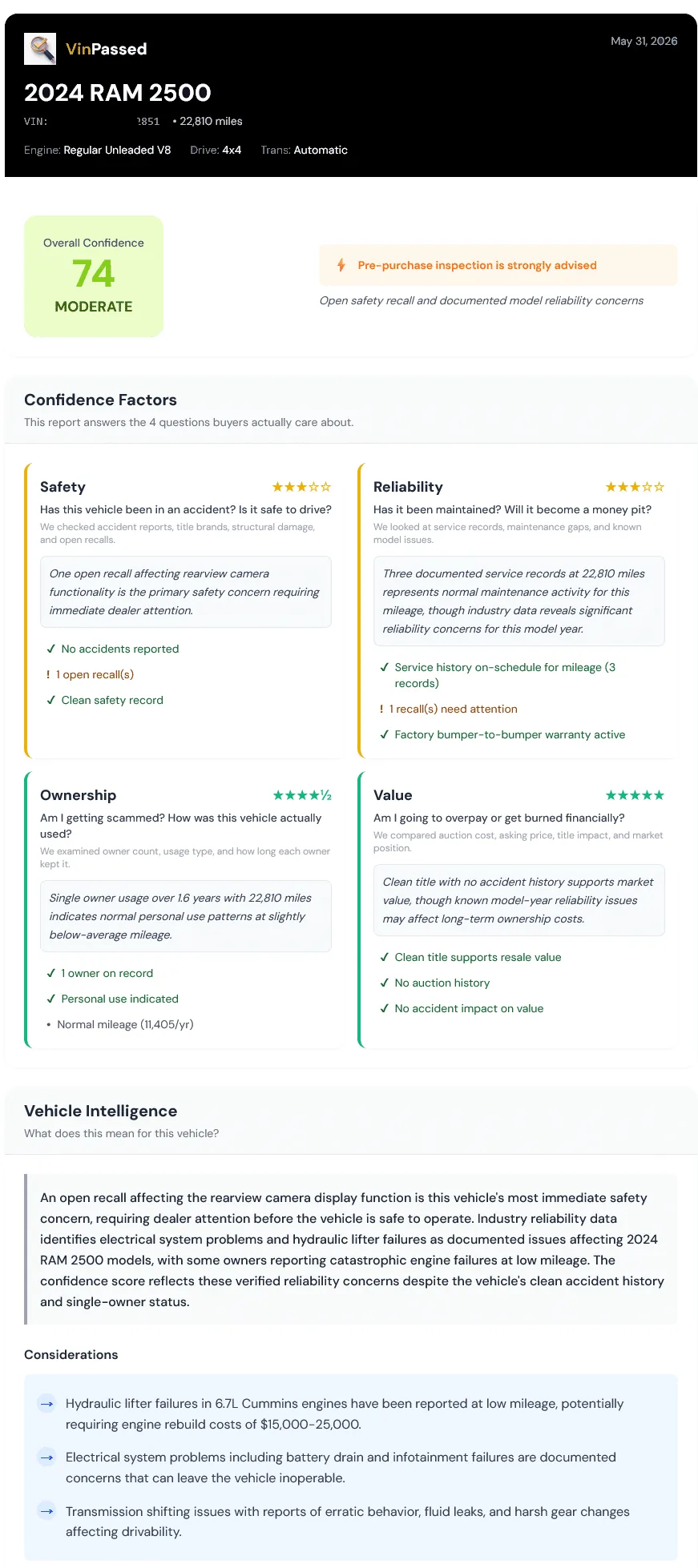
The valuation and ownership-cost depth
This is the easiest difference to show. A vehicle history report tells you what happened to a car. What most buyers also need, and have to go assemble from separate valuation and repair-estimate sites, is what the car is worth and what it will cost to own. VinPassed pulls that into the report itself: a market-value matrix across trade-in, private, and dealer prices at each condition grade (a spread, not a single number), projected per-mile and multi-year ownership costs benchmarked to the segment, a maintenance forecast showing what's overdue and what's coming with cost ranges, and model-specific repair estimates. Carfax and AutoCheck don't bundle this; you'd normally visit three or four sites to recreate it. The figures are estimates based on industry averages, but having them in one place changes how you evaluate a price.
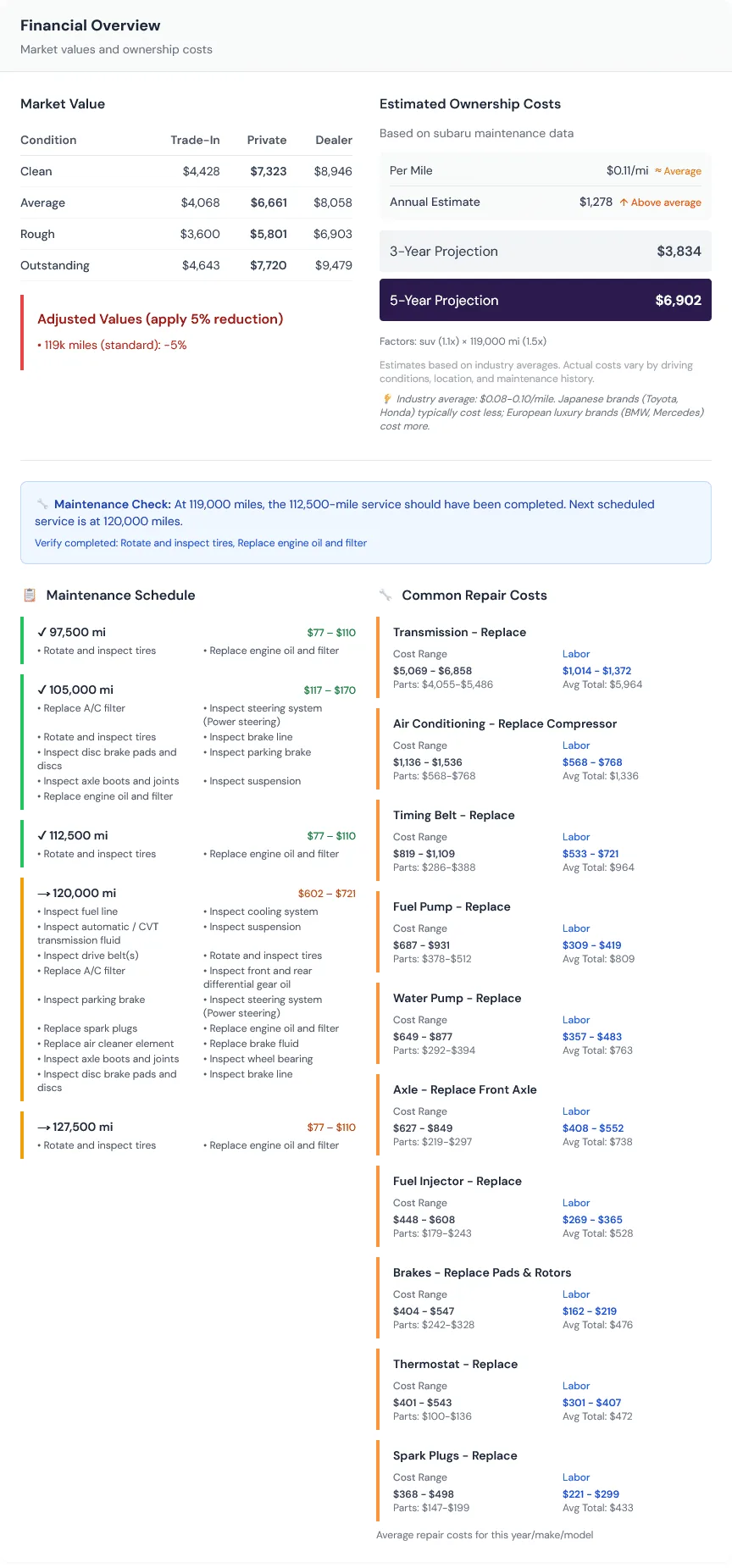
Is a clean Carfax really clean?
A clean Carfax doesn't mean no accidents. It means no accidents reached Carfax's data sources. Carfax itself says its reports are based only on information supplied to it. A car with auction-documented damage can still read clean if that damage was never reported through traditional channels. This is the exact gap auction photos close, when the car has auction history to pull from.
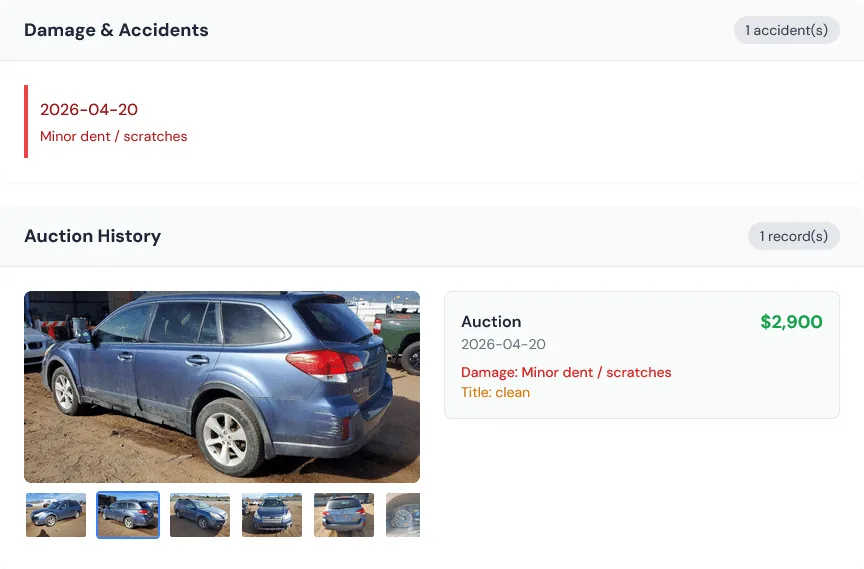
A real example
A 2015 Maserati Ghibli was listed as "no accident damage" with a clean Carfax. Auction photos showed severe front-end damage and a salvage-title history, with auction-estimated repairs around $25,900. The dealer had paid roughly $16,000 at auction and listed it near $23,500. None of that was visible on the clean report. This is the kind of case where pre-reconditioning auction evidence, when it exists, tells a different story than the database alone.
How do Carfax alternatives compare on price and features?
| Data Category | Carfax | AutoCheck | VinPassed | VinAudit |
|---|---|---|---|---|
| Core history (title, accident, theft, recalls) | ✓ | ✓ | ✓ | Limited |
| Service-record depth | Strongest | Good | Good | ✗ |
| Buyback guarantee (title brands; terms apply) | ✓ | ✗ | ✗ | ✗ |
| Comparative / confidence score | ✗ | ✓ | ✓ (reasoning shown) | ✗ |
| Auction photos (when available) | ✗ | ✗ | ✓ | ✗ |
| Dealer acquisition cost (when available) | ✗ | ✗ | ✓ | ✗ |
| Market value spread (trade-in / private / dealer) | ✗ | ✗ | ✓ | ✗ |
| Projected ownership cost | ✗ | ✗ | ✓ | ✗ |
| Maintenance forecast & repair estimates | ✗ | ✗ | ✓ | ✗ |
| Single-report price | $49.99 | $29.99 | $30 | $9.99 |
That's the four options most buyers weigh. For the price behind each column, see how much a Carfax report costs. The complete side-by-side comparison extends this grid to Bumper and EpicVIN, adds multi-report pricing and the buyback-guarantee fine print, and is re-verified against each provider's published pricing and sample reports (last checked October 2026), including the rows where we lose.
Which Carfax alternative is right for you?
- Dealer offers a free Carfax? Take it, and take advantage of its strong service records. Treat it as one input, not the whole story.
- Paying and want the same core history cheaper? AutoCheck at $29.99, or a $9.99 NMVTIS title check for the bare basics.
- Want what Carfax doesn't carry, auction condition, dealer cost, forward-looking risk? That's the case for VinPassed, on top of the same core history.
- Just need a title/theft screen? A $5 title and stolen check is the floor, and it credits toward a full report.
- Something feels off? Run two reports. The discrepancy between them is often the finding.
What if something is wrong after you sign?
Whichever report you use: if something turns out wrong after purchase, you're generally the one who has to prove misrepresentation or a pre-existing defect, and what you're entitled to varies a lot by state. Documenting the car's history before you sign matters more than trying to act afterward. Our state-by-state used car buyer protection guide covers where you stand. This isn't legal advice.
For the wider view, including how Carfax and AutoCheck stack up on their own merits alongside these alternatives, see our full best vehicle history report comparison.
The full comparison
Every major report side by side, Carfax, AutoCheck, VinAudit, Bumper, EpicVIN, and VinPassed, with pricing and exactly what each one shows a buyer.
See the full side-by-side →Frequently Asked Questions
Common questions about Carfax alternatives and how to choose one.
It depends what you want Carfax to do. For the same core history (title, accident, theft, recalls) at lower cost, AutoCheck at $29.99 and NMVTIS-direct providers like VinAudit at $9.99 cover it. For data Carfax doesn't include at all, auction photos, what the dealer paid, and forward-looking ownership cost, that's the gap VinPassed was built to fill. There's no single best; there's a best for your situation.
For core records, the major options pull from the same federal and insurance-linked sources, so reliability is broadly comparable. Carfax has more insurance-company partnerships for accident data; some alternatives add auction-sourced data Carfax doesn't carry. No single report catches everything, which is why running two on a high-value purchase is reasonable.
Largely brand and market position. Carfax was first to market and became the default, and at $49.99 a single report it's the most expensive of the mainstream options. The price reflects recognition more than uniquely superior data, which is why many buyers look at alternatives that cost less for comparable core history. Our Carfax cost breakdown shows every package price.
Like every text-based report, Carfax can only show what was reported to its sources. Accidents repaired out of pocket, or damage before a dealer acquired the car, can be absent. It's not unique to Carfax; it's a limit of the whole category. The honest gap specific to Carfax is that it doesn't include auction photos or dealer acquisition cost, which some alternatives do when the car has auction history.
Some of it, free. NHTSA covers recalls and NICB VINCheck covers theft and salvage flags at no cost. They don't carry individual accident history, valuation, or auction data. A free VIN check is a legitimate first filter; a paid report fills in the specific car's history. For Carfax itself, see is Carfax free.
Beyond the free recall and theft lookups, the cheapest meaningful step is a title and stolen check. VinPassed's is $5 (all 50 states, NMVTIS theft/salvage) and credits toward a full report if you upgrade; VinAudit's NMVTIS title basics run $9.99. These rule out title problems quickly but don't include accident detail or analysis.
Not every car goes through auction; trade-ins and clean private-party cars often don't. When there's no auction record, auction photos and dealer cost simply aren't available from any provider. You still get title, accident, theft, and ownership history, and a pre-purchase inspection matters more in those cases.
Carfax alternatives are part of a bigger comparison that also weighs Carfax and AutoCheck on their own merits. We rank the full field and explain where each fits in our best vehicle history report comparison.