How to Negotiate Used Car Price Like a Pro

The salesperson says the price is firm. They claim they're already losing money. They insist this is the best deal you'll find anywhere.
They're almost certainly not telling the truth.
Used car dealers typically mark up vehicles 20-40% above what they paid. They have room to negotiate used car price—they just don't want you to know how much room. The FTC advises always researching prices before buying.
This guide shows you exactly how to negotiate used car price using data, timing, and tactics that put you in control of the conversation.
Know What the Dealer Paid
VinPassed shows auction sale prices—the actual amount dealers paid for their inventory. That's the number they don't want you to know.
View Sample Report →Your Four Leverage Points to Negotiate used car price
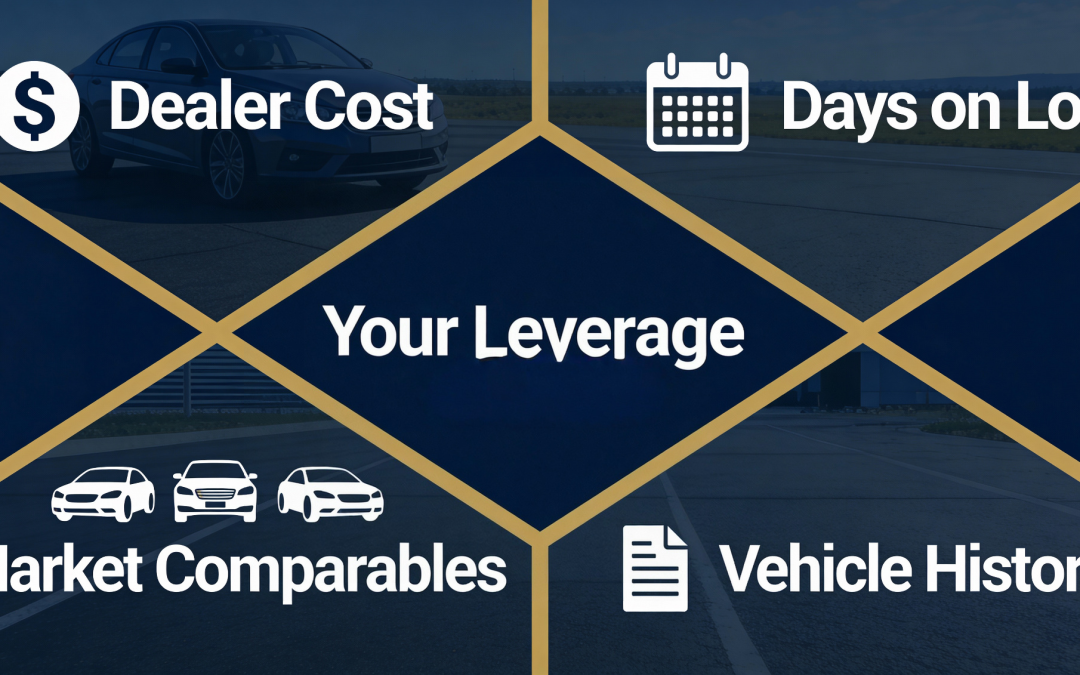
Successful negotiation of used car price isn't about being aggressive or playing games. It's about having information the dealer assumes you don't have. Here are your four key leverage points:

Let's break down each one and show you how to use it.
The 7 Tactics That Actually Work to negotiate used car price
This is your most powerful tool. If the dealer paid $15,000 at auction and they're asking $22,000, you know there's at least $7,000 in margin to work with.
VinPassed shows auction sale prices for vehicles that went through Manheim, ADESA, Copart, or IAAI. Run the VIN before you negotiate use car price—this single data point changes the entire dynamic.
A reasonable offer is dealer cost plus 15-20% for reconditioning and profit. Anything above that is negotiable.
Dealers pay "floor plan" interest on every car sitting unsold—typically $20-40 per day. A car that's been on the lot for 60+ days is costing them money daily.
Check the listing date on sites like CarGurus, Autotrader, or Cars.com. If it's been listed for 45+ days, the dealer is motivated. After 90 days, they're often desperate.
VinPassed also shows dealer listing history—when the car was first listed and any price drops along the way.
Know what similar vehicles are selling for within a 50-mile radius. Use:
- CarGurus (shows "fair deal" vs "overpriced" ratings)
- Autotrader (filter by year, mileage, trim)
- Facebook Marketplace (often lower prices)
- KBB and Edmunds (for valuation ranges)
If you find three comparable cars priced $2,000 lower, you have concrete evidence for your offer.
Any negative history justifies you negotiate a used car price reduction:
- Previous accidents (even ones Carfax missed)
- Multiple owners in short time
- Service gaps or missing maintenance
- Auction damage documented in photos
- Out-of-state title (possible title washing)
Even if you're willing to accept these issues, they're negotiating chips. "I see this car was in an accident in 2022. I'm still interested, but that needs to be reflected in the price."
Dealers love to negotiate on monthly payments because they can manipulate the loan term to make any price seem affordable. A $400/month payment sounds reasonable until you realize it's a 72-month loan at 12% interest.
Always negotiate the out-the-door price first. That's the total amount you'll pay including taxes, fees, and any add-ons. Only discuss financing after you've agreed on price.
Your strongest negotiating position is genuine willingness to leave. If the dealer knows you'll walk, they'll find room in the price. If they sense you're emotionally attached, they won't budge.
Set your maximum price before arriving. If they won't meet it, thank them and leave. Often, you'll get a call within 24 hours with a better offer.
There's always another car. Never let urgency cost you thousands.
Timing affects dealer motivation:
- End of month: Salespeople need to hit quotas
- End of quarter: Even more pressure to move inventory
- Monday/Tuesday: Less traffic means more attention and flexibility
- Rainy days: Fewer customers = more desperate sellers
- End of year: Dealers clearing inventory for new models
Sample Negotiation Scripts
Here's how to use your research in the actual conversation:
Opening (After Test Drive)
What to Say
"I like the car and I'm ready to buy today if we can agree on price. I've done my research and I know what this car is worth. What's your best out-the-door price?"
Let them make the first move. Their "best price" is never actually their best price—it's where negotiation begins.
Using Dealer Cost
What to Say
"I pulled the auction history on this VIN. It sold at Manheim in October for $16,400. I understand you need to make a profit and cover reconditioning, but $24,000 is a 46% markup. I'm prepared to pay $19,500, which gives you a fair margin. Can we make that work?"
Using Time on Lot
What to Say
"I noticed this car has been listed for 67 days. I'm sure you'd like to move it and free up that floor plan cost. If you can do $18,000 out the door, I'll take it today and save us both time."
Using Vehicle History
What to Say
"The vehicle history shows a front-end collision in 2023 with $4,200 in repairs. I'm still interested, but that affects the car's value by at least $2,000-3,000. Your asking price needs to reflect that."
Walking Away
What to Say
"I appreciate your time, but we're too far apart. My budget is firm at $19,000 out the door. If anything changes, here's my number. I'll be looking at a few other options this weekend."
Pro Tip: Bring Printed Documentation
Print your VinPassed report, comparable listings, and any vehicle history issues. Physical evidence is more persuasive than saying "I looked it up." It shows you're serious and informed.
What Not to Do
Avoid these common mistakes that weaken your negotiating position:
| Mistake | Why It Hurts You |
|---|---|
| Revealing your maximum budget | They'll price exactly to that number |
| Showing emotional attachment | Signals you'll pay more to get "your" car |
| Discussing monthly payments first | Allows manipulation of terms to hide true cost |
| Negotiating trade-in and purchase together | Creates confusion they can exploit |
| Coming unprepared | No leverage = no negotiating power |
| Being rude or aggressive | People don't give deals to jerks |
How Much Can You Actually Save?
Realistic savings from effective negotiation:
- Average savings: $1,500-3,000 on most used cars
- High-margin vehicles: $3,000-5,000+ (luxury cars, trucks, SUVs)
- Long-sitting inventory: $2,000-4,000 (60+ days on lot)
- Vehicles with history issues: $1,000-3,000 additional discount
The $25 cost of a VinPassed report regularly saves buyers 100x that amount in negotiations.
Don't Forget the Back End
Even after agreeing on price, the finance office will try to add dealer-installed accessories, paint protection, fabric coating, extended warranties, and other high-margin products. These are heavily negotiable or can be declined entirely. "No thank you" is a complete sentence.
After the Deal: Protect Your Purchase
Once you've negotiated a fair price, consider mechanical protection—especially if the vehicle has any history concerns. Always complete a thorough pre-purchase inspection before finalizing.
Dealer-offered warranties are typically overpriced with limited coverage. VIP Warranty offers exclusionary coverage (virtually all mechanical components) for vehicles up to 250,000 miles, often at lower cost than dealer options. Worth comparing before signing anything in the finance office.
The Bottom Line
Negotiating a used car price isn't about tricks or pressure tactics. It's about knowing more than the salesperson expects you to know.
Your preparation checklist:
- Run a VinPassed report to find dealer cost and vehicle history
- Check how long the car has been listed
- Research 3-5 comparable vehicles in your area
- Set your maximum price before arriving
- Calculate a fair offer: dealer cost + 15-20%
- Be ready to walk away if they won't negotiate fairly
Armed with data, you're no longer negotiating blind. You know what they paid, what the car is worth, and what a fair deal looks like. It's time to negotiate used car price like a pro
That changes everything.
Get Your Negotiation Advantage
Get a VinPassed Report for $25
Dealer cost • Auction history • Days on market • Full vehicle history
Check Any VIN Now →Frequently Asked Questions
How much can you negotiate used price on a car at a dealership?
Typically 10-20% off the asking price, depending on the dealer's margin and how long the car has been on the lot. With auction cost data, you can calculate exactly how much room exists. High-margin vehicles and long-sitting inventory offer the most negotiating room.
Is it rude to make a low offer on a car?
No. It's business. A respectful, data-backed offer is never rude—even if it's significantly below asking price. What matters is how you present it. "Based on my research, I'm prepared to pay X" is professional. "This car isn't worth what you're asking" is confrontational.
Should I tell the dealer my maximum budget?
Never. Once they know your ceiling, that becomes the floor for negotiation. Keep your maximum to yourself and negotiate based on market data and vehicle value instead.
What’s the best day to buy a used car?
End of month (quota pressure) combined with a weekday (less traffic) typically offers the best combination. Monday or Tuesday at the end of the month is ideal. End of quarter and end of year add additional pressure.
How do I find out what the dealer paid for a used car?
Run the VIN through VinPassed. If the vehicle went through auction (most do), the report shows the actual sale price. This is the dealer's cost before reconditioning—your baseline for calculating a fair offer. Start with a free VIN check for basics, then get the full report for negotiation data.